Blog Archive

Showing posts with label Guatemala. Show all posts

Wednesday, 8 November 2017

Sumpango Kite Festival


'Let's go fly a kite...'


The Sumpango Kite Festival is much more than just a few people flying kites in a field. Before coming to Guatemala we had never heard of this event, but it is a very important date in the diary for tens of thousands of Guatemalans, and thanks to the Ocean Cruising Club organising a tour to visit it, we got a chance to experience this truly amazing event first hand.

The Sumpango Kite Festival is part of the Dia de los Muertos (Day of the Dead) celebrations. The Day of the Dead is a celebration that takes place on 1 November each year, when Guatemalans remember their dead loved ones. They believe that souls of all people that have passed away return to earth on this day to check up on their families. 


One of the most popular traditions on this day is to visit the cemeteries. Some merely lay flowers on the mausoleums and say a prayer for the souls of their dear departed. Some however, take it to another level. They arrive dressed in their best clothes, with a picnic, and spend the whole day and night 'visiting' their deceased loved ones. Tradition says that a plate of food must also be served to the one who you are visiting. As night approaches, it turns into a big party, where the living celebrate with the dead. Whilst this tradition may seem weird to some other cultures, the idea behind it is actually quite sweet. On arrival in Sumpango we passed through the cemetery, and the care and attention that was being paid to tending to the graves was heart warming. Children were flying kites off the mausoleums whilst others were covering mounds with long grasses and flowers. There was a lot of pride in what they were doing. It was fascinating to watch, but we didn't stay long as we felt we were intruding.


Sumpango cemetery Day of the dead festival


Sumpango cemetery Day of the dead festival


Grandmother and child at Sumpango festival


So, how does the Kite Festival in Sumpango tie into the Day of the Dead celebrations? Legend has it that the festival was born many years ago when the residents of Sumpango sought the help of a Witch Doctor to rid them of annoying and bothersome spirits. A sort of latter day Ghostbuster. The Witch Doctor suggested they get big pieces of paper and let them fly in the wind and make lots of noise to scare off the unwanted spirits. Eventually, somebody figured that kites are a more effective spirit-scaring device, and that's how the tradition was born. 


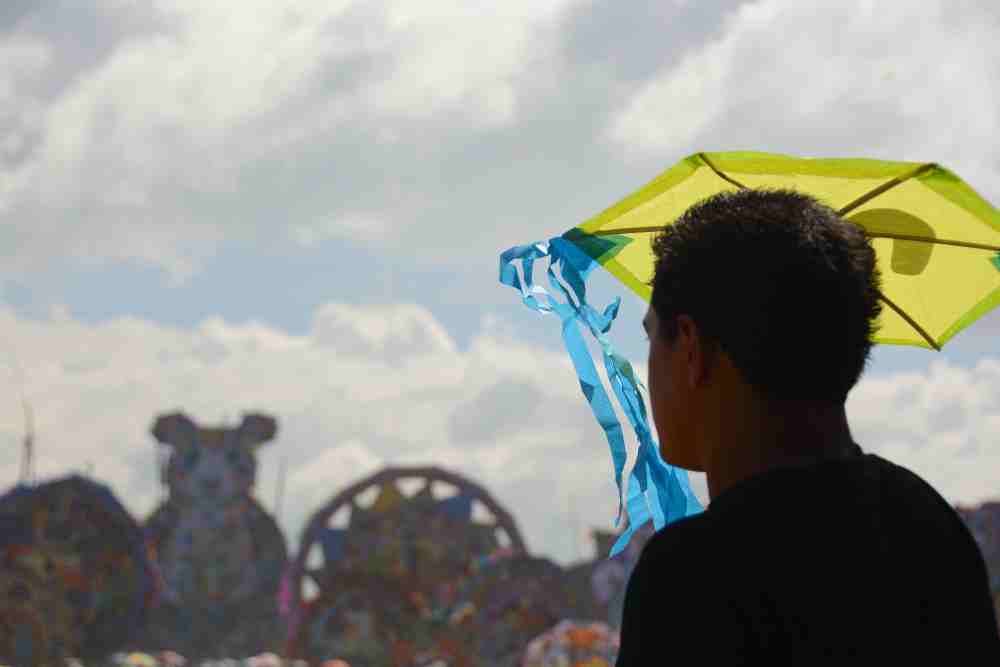
Every year at Sumpango people gather to show off their kites in a large field above the town and the cemetery. What makes it unique is the size of the kites. Some are huge! The Kites or 'Barilletes Gigantes' are constructed with tissue paper, tape and bamboo struts. They range in size from 2 metres to 12 metres in height and are truly amazing. Some of the bamboo struts holding them together are thicker than a human arm! Many community groups take up to seven months making their kites and there is big prize money for the winning ones, so it is taken very seriously.


Kite at Sumpango festival 2017


Kite at Sumpango festival 2017


Kite at Sumpango festival 2017


Kite at Sumpango festival 2017


Kite at Sumpango festival 2017


Sumpango kite festival 2017


Sumpango kite festival 2017


Sumpango kite festival 2017


Sumpango kite festival 2017


Sumpango kite festival 2017


Sumpango kite festival 2017


When it came to flying the kites, it took a group of between 4 and six people to hold on to the line attached to the kite. These people had to run backwards and forwards through the huge crowds, to allow the kites to catch the wind, gain momentum and fly. On more than one occasion, a kite would fly briefly then come plummeting down on the heads of unsuspecting spectators. This would cause much delight to some, and no doubt injuries to others, and all would be met with 'Oohs' and 'Aahs' from the crowd. On one occasion, a kite crash landed on top of a roof of a nearby structure as its tail got wrapped around the line of a kite already flying.


Kite flying at Sumpango kite festival 2017


Kite flying at Sumpango kite festival 2017
Sumpango kite festival 2017


There was an all ladies team who proved to be a big hit. Their kite was a very pretty blue one, and the ladies flying the kite got lots of applause from the crowd. 

We got to see the 2,4 and 6 metre kites fly, but sadly had to leave before the 8 metre ones went up. We understood that they don't fly the really big kites. They are merely judged on their appearance and the message portrayed within. 


There were reportedly 125,000 people at the event this year. We can't say if that was the case, we doubt that very much, but it was packed. There were people as far as the eye could see. It is the first time we had been amongst so many people in a very long time, and at times it was a bit scary as the crowds bottle-necked to get through an exit. 


Sumpango kite festival 2017


The area all around the field had stalls selling food, clothes and gifts.


Street stalls at Sumpango kite festival 2017


Street stalls at Sumpango kite festival 2017


Street stalls at Sumpango kite festival 2017


Musicians playing at Sumpango kite festival 2017


Street stalls at Sumpango kite festival 2017


Feeling certain that no troublesome spirits where still in the vicinity, we made our way back. Our coach was too large to get anywhere near the action, so we had a fair walk back to the main road and rendezvous place. Remarkably, out of a party of 29, none of our group got lost. We all spent the journey back to our hotel in Antigua exchanging stories of our experiences. Unfortunately, one or two in the group had suffered at the hands of pickpockets, despite being warned of the danger


Later that evening and back in Antigua, we came across hundreds of men dressed in black suits. In the street outside the hotel we were greeted by large clouds of incense and yet more people dressed in black. It was obvious that they were part of a parade, so we went up to the balcony on the first floor of the hotel to watch the procession unfold. We later learned that it was the annual Antigua procession commemorating the Souls of the Departed. The Roman Catholic Escuela de Jesus (school of Jesus) created a float with the lifeless body of Jesus being mourned by the Virgin Mary, the Angel Gabriel at hand, borne by numerous men and women throughout the streets. Dirge-playing marching bands and robed marchers followed. The parade honours the spirits of the ancestors, those who suffered and died, and those who carry great burdens. So, that explained why there were so many men dressed in black! The float was enormous, with over 100 men carrying it. Lynne counted 50 men down each side of the float, three men at the front and three men at the rear. Those in the middle at the front and back 'swung' the float from side to side, whilst the men on each side carried it forward. 


Souls of the departed procession Antigua Guatemala


Souls of the departed procession Antigua Guatemala


In the next update we will talk a little about our time in the old capital of Antigua, and our short visit to lake Atitlan.

Friday, 13 October 2017

Tikal


Visit to Tikal


Thanks to Kelly Piercy, the local Port Officer of the Ocean Cruising Club, an excursion was arranged to visit the Mayan ruins at Tikal. Tikal happened to be at the top of our list of places to visit during our time in Guatemala, and we weren't disappointed.


A total of 23 of us departed Fronteras at about 9am on 26 September. Kelly had arranged to pick everyone up from their individual marinas in his lancha (rigid wooden dinghy) so that we didn't have to leave our own ribs and dinghies at the town dock. Things started out well, but on his last run to pick up passengers from RAM marina, Kelly's outboard stopped working and refused to start again. After a quick call to Hugo, a local lancha driver, Kelly's lancha was towed to the town dock, with all remaining passengers shared between the two lanchas.


Photo of a lancha being towed by another lancha, taken on the Rio Dulce, Guatemala

Kelly's lancha being towed


Photo of a tour group standing in front of a bus

Group photo...everybody smile!

Our bus journey took us to hotel La Casa Don David on the shores of Lago Peten Itza in El Remate, where we would spend two nights. We arrived at the hotel at approximately 2.30pm and immediately enjoyed the comfort of our air conditioned bedroom, and took a shower after the long and hot ride. El Remate is famous for its wood carvings and whilst there, we visited a working wood carving studio.


Wood carver showing customers some of his wares. Taken in El Remate, Guatemala
Wood carver explaining some of the carvings

Selection of wood carvings on display in a shop in El Remate, Guatemala
Selection of carvings

Selection of wood carvings on display in a shop in El Remate, Guatemala


Close-up photo of a bowl being carved out of wood. Taken in El Remate, Guatemala

Wood carving in progress

Later that afternoon we took a short bus trip to the nearby island town of Flores to watch the sunset, and have a bite to eat before returning to El Remate. Sadly, this being rainy season, we didn't get to experience one of the famous sunsets that are usually seen from the Sky Bar in Flores. Never mind, we all got to enjoy some Happy Hour cocktails instead.


Photo of the outside of the Sky Bar in Flores, Guatemala
Sky Bar

Photo of a street scene in Flores, Guatemala

Street scene in Flores

Photo of a street scene in Flores, Guatemala

Photo of a cocktail sitting on a wall with Lake Peten Itza in the background
Cocktail in the Sky Bar

Photo of a group of people sitting on the terrace of the Sky Bar in Flores, Guatemala, looking at the sunset
Waiting for the sunset, sipping cocktails

Photo of a cocktail on a table
Lemonade and ice, very refreshing

Photo of a cloudy sunset over Lake Peten Itza, taken from the terrace of the Sky Bar in Flores, Guatemala

Not the sunset we hoped for, but nice anyway

Our departure time the following morning to go to Tikal was 5am, so on arrival back at El Remate, we retired for an early night.


Our guide, Oliver, met us bright and early at the hotel and accompanied us on the short bus ride from the hotel to the Tikal National Park. He navigated us through jungle paths to the many ruins, and pointed out local flora and fauna along the way.


Tikal is the ruins of an ancient Mayan city which was discovered in 1853, but excavation work did not begin until the 1950's. In 1979, it was declared a UNESCO World Heritage Site. It is one of the most interesting and enjoyable of the Mayan sites to visit, largely due to its remoteness, but also its jungle setting. The park is approximately 570 square kilometres and the city of Tikal covered an area greater than 16 square kilometres, which included 3,000 structures. Only a fraction of these structures have been uncovered, in what was the centre of the city. Sadly, due to lack of funds, it is unlikely that more temples will be uncovered anytime soon.


The ancient city of Tikal is set on a low hill, surrounded by low-lying swampy ground. One of the reasons the Mayans may have settled here is due to the abundant fertile upland soils, and the abundance of flint. The wealth of this valuable stone meant they were able to build good tools, and the flint could be traded for other goods. Tikal had no water other than what was collected from rainwater and stored in reservoirs. It is believed the site was inhabited from the 6th century BC to the 9th century AD.


The architecture of the city was built from limestone and includes the remains of temples that tower over 70 metres high, large royal palaces, in addition to a number of smaller pyramids, palaces, residences, administrative buildings, platforms and inscribed stone monuments. The limestone was quarried onsite. The depressions formed by the extraction of the limestone were plastered to waterproof them and were used as reservoirs. The main plazas in the city were surfaced with stucco and laid to a gradient that channelled rainfall into a system of canals that fed the reservoirs.


It is believed that one of the reasons that led to the Mayans eventually abandoning the site in the mid 900's AD was due to over population, deforestation, erosion and nutrient loss.


At the heart of the city is the Gran Plaza. It is flanked on the east and west sides by two great temple-pyramids. On the north side it is bordered by the North Acropolis and on the south side by the Central Acropolis.


Photo of an Ocellated Turkey, taken at Tikal National Park, Guatemala

Ocellated Turkey

Photo of an Ocellated Turkey, taken at Tikal National Park, Guatemala

Close up of Ocellated Turkey

Photo of a Keel-billed Toucan taken at Tikal National Park, Guatemala
Keel-billed Toucan

Photo of a group of people walking through the jungle trails at Tikal National Park, Guatemala

Walking through one of the many jungle paths

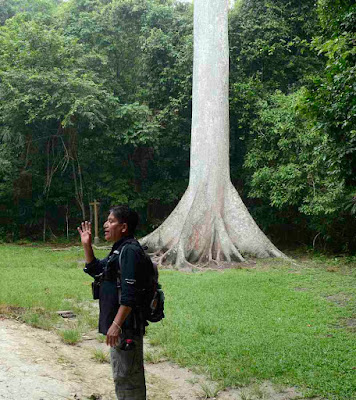
The Ceiba Tree is not only Guatemala's National Tree, but it is the sacred tree of the Maya. Some species can grow to 70m or more and have a straight, largely branchless trunk with a huge spreading canopy and buttress roots that can be taller than a grown person. For the Maya, the tree represents the axis mundi, the stable world centre. It constitutes a symbolic vertical line. The line of balance that unites the three realms of the underworld, the earth and the heavens. It is considered a 'Tree of Life' by the Maya. The axis mundi is the 'navel of the world' and is an important symbol to both Guatemala and the Maya.

The Ceiba tree below is thought to be over 100 years old.

Photo of a guide at Tikal standing infront of a Ceiba Tree

Guide Oliver in front of a large Ceiba Tree

Photo of a Golden Silk Orb Weaver Spider in Tikal National Park, Guatemala
Golden Silk Orb Weaver Spider

Photo of a giant spiders web at Tikal National Park, Guatemala

Photo of a thatched rest area in Tikal National Park, Guatemala

Taking a short rest out of the sun

Photo of some ruins in Tikal National Park, Guatemala


Templo I (Temple I) is known as the Templo del Gran Jaguar (Temple of the Grand Jaguar). It was built to bury and honour King Ah Cacao (King Chocolate). The temple was erected above his tomb and the King's rich burial goods included stingray spines, which were used for blood-letting, 180 jade objects and 90 pieces of bone carved with hieroglyphs. At the top of the 44m temple is a funerary shrine. The roof comb that crowned the temple was originally adorned with reliefs and bright paint.


Side view photo of Temple I at Tikal National Park, Guatemala
Temple I


Photo of some ruins in Tikal National Park, Guatemala


Photo of a guide at Tikal demonstrating the accoustics between Temples I & II
Our guide demonstrating the amazing acoustics between the temples

Templo II (Temple II) is located on the west side of the Gran Plaza. It was built by King Ah Cacao in honour of his wife. It is the most thoroughly restored of the major temples at Tikal. We were able to climb to the top of the temple via a set of wooden steps erected around the back of the temple, to protect the temple from damage. Two badly eroded giant masks adorn the upper platform and give the temple its other name of The Temple of Masks. The roof comb is highly ornate and bears the sculpture of a face with circular ear spools.


Photo looking up at Temple II in Tikal National Park, Guatemala

Temple II

Photo showing external wooden steps erected around Temple II in Tikal National Park, Guatemala

External steps to the top of Temple II


Photo of Temple 1 in Tikal National Park, taken frtom the top of Temple 2

Looking across the Plaza to Temple 1


Photo of the top segment of Temple 2 in Tikal National Park, Guatemala


Photo of a sculpture on the top segment of Temple 2 in Tikal National Park, Guatemala

Photo showing the platform around the top segment of Temple 2 in Tikal National Park, Guatemala

Platform around the top of Temple II with Temple I in the distance

Templo IV (Temple IV) is a Mesoamerican pyramid. It was one of the tallest buildings in the Maya World. The pyramid is 64.6 metres high and rises way above the jungle canopy, affording spectacular views over the whole site and had a part to play in a famous film. In “Star Wars Episode IV: A New Hope”, Luke, Hans Solo and crew land the Millennium Falcon on Yavin 4, a jungle covered moon. It’s from here that the heroes launch their attack on the Death Star.

Once again, we were able to climb to the top of this structure, thanks to a set of wooden steps erected nine years ago up one side of the pyramid. From here, you can clearly see the tops of other structures also poking through the jungle canopy. Despite it being an overcast day with lots of cloud cover, the sight was still breath taking.


Photo of some people taking a rest on the steps at the top of Temple 4 in Tikal National Park, Guatemala

Taking a break to enjoy the view from the top of Temple IV


Photo of the view from the top of Temple 4 in Tikal National Park, Guatemala
View from the top of Temple IV

Photo of the view from the top of Temple 4 in Tikal National Park, Guatemala


Photo of some people taking a rest on the steps at the top of Temple 4 in Tikal National Park, Guatemala

A few of the group enjoying the view
Photo of a bread oven carved out of the limestone in Tikal National Park, Guatemala
Close-up photo of a Tikal Crab Spider taken at Tikal National Park, Guatemala
Tikal Crab Spider

Close-up photo of a cricket in Tikal Natioinal Park, Guatemala
A well disguised cricket

Close-up photo of a Tiger Ant in Tikal National Park, Guatemala
Tiger ant close up

Below are some more photos taken around the vast site.

Photo of a guide in Tikal National Park pointing out one of the ruins
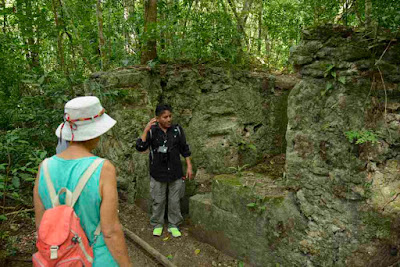
Oliver our guide explaining the significance of another ruin

Photo of a jungle path in Tikal National Park, Guatemala
Wish you could hear all the jungle sounds

Photo of some ruins in Tikal National Park, Guatemala
Temple showing repaired excavations at the front

Photo of some ruins in Tikal National Park, Guatemala

Close-up photo of one of the many plants in Tikal National Park, Guatemala


Photo of some ruins in Tikal National Park, Guatemala

Photo of some ruins in Tikal National Park, Guatemala

Photo of some ruins in Tikal National Park, Guatemala

Photo of some ruins in Tikal National Park, Guatemala

Photo of some ruins in Tikal National Park, Guatemala


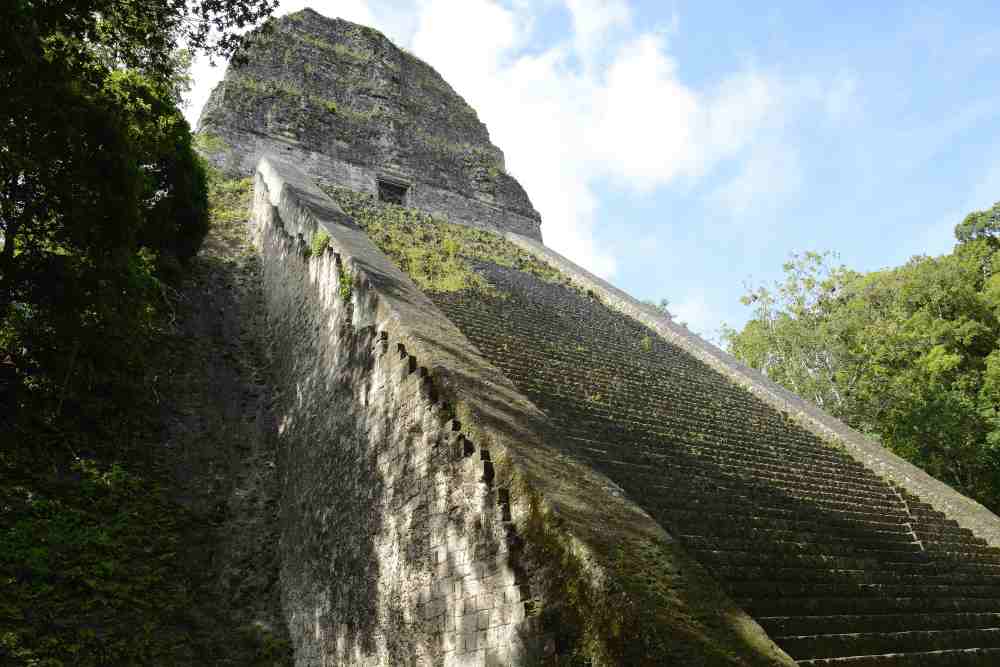
Temple V is the most recently excavated Temple and stands at 187 feet high. It is actually a mortuary pyramid of an as yet unknown ruler.

Photo of Temple 5 in Tikal National Park, Guatemala
Temple IV

Photo of a guide at Tikal National Park drawing the Maya calendar in the sand
Our guide explaining the Mayan Calendar


Close-up photo of a monkey relaxing in a tree in Tikal National Park, Guatemala
Monkey relaxing in a tree

Photo of a Geoffroy's Spider Monkey swinging through the trees in Tikal National Park, Guatemala

Geoffroy's Spider Monkey

Photo of a Geoffroy's Spider Monkey swinging through the trees in Tikal National Park, Guatemala
Spider Monkey swinging in the trees above our heads

Photo of some ruins in Tikal National Park, Guatemala


Photo of some ruins in Tikal National Park, Guatemala

Photo of some ruins in Tikal National Park, Guatemala

Photo of some ruins in Tikal National Park, Guatemala


Below are copies of some of the artefacts found at the site in the museum by the entrance to the park.

Photo of an exhibit of teeth adorned with Jade in the Museum at Tikal National Park, Guatemala

For a dazzling smile insert Jade 

Photo of a replica of a stone adorned with Maya heiroglyphs on display in the Museum in Tikal National Park, Guatemala

Stunning replica, the real one is in Guatemala City

Photo of a gift shop displaying hats in Tikal National Park, Guatemala
One of the many souvenir stalls in the park

Some water birds in a pond which also houses three crocodiles, who were too shy to be seen the day we visited.

Photo of a wading bird in Tikal National Park in Guatemala


Photo of a Northern Jacana Wading Bird taken in Tikal National Park, Guatemala
Northern Jacana Wading Bird


After our fascinating day at Tikal, we took a wander around the town of El Remate, where we found wild pigs roaming free along the road and on the lake shore.

Photo of wild pigs on the lake shore in El Remate, Guatemala

Photo of Lake Peten Itza taken from the Casa Don David Hotel in El Remate Guatemala
At the back of the hotel

Photo of two ladies carrying heavy loads on their heads, walking down the street in El Remate Guatemala

Outside the front of the hotel

The hotel has various bird feeders to attract the local birds, and we were lucky enough to see lots of hummingbirds.

Close-up photo of a Hummingbird taken at Casa Don David Hotel in Ela Remate Guatemala
So cute

Close-up photo of a Hummingbird taken at Casa Don David Hotel in Ela Remate Guatemala

The flash on the camera came in useful

The hotel also has a large Ceiba tree in the grounds. According to the owner, the tree was planted on 1 January 2000 by his ex gardener who was of Mayan descent. As there was widespread panic at the time that the world was going to end as the Millennium approached, the gardener planted the tree to protect them. At only 17 years old, the tree is already immense in size and a real focal point for visitors. That evening, we were treated to a fire show around the tree.

Photo of a Ceiba Tree in the grounds of Casa Don David Hotel in El Remate Guatemala
17 year old Cieba tree

After a hearty breakfast on our last day, we boarded the coach back to the Rio Dulce, making a stop at Finca Ixobel for lunch.


Photo of Finca Ixobel in Guatemala
Entrance to Finca Ixobel

Finca Ixobel is an ecological resort amongst pine forests and patches of jungle. The grounds contain a natural pond, and some of our group dived in for a refreshing dip before lunch.


Photo of the grounds at Finca Ixobel in Guatemala
Beautiful Setting

Photo of a sign showing a 'No Guns or Knives' logo, taken at the bar at Finca Ixobel Guatemala
No guns or knives inside the bar

Photo of some people swimming in the natural pool at Finca Ixobel in Guatemala
Thankfully no alligators

It was a truly wonderful few days, and we look forward visiting Chichen Itza in Mexico next year to see the Mayan temples there.


For now it is back to Tijax and marina life. We do have another exciting excursion coming up, a five day trip to include a visit to the city of Antigua, Lake Atitlan and attend the famous Sumpango Kite Festival. Our trip coincides with Dia de los Muertos (the day of the dead) which we will explain more about in the blog entry for the trip.


Work has started on removing the old teak deck, which is very exciting, and we have downloaded a free cruising guide for the places we hope to visit next year. Our Panama Canal transit still seems a long way off, but we are determined to head South in 2019. In the meantime, we are continuing to love every minute of our stay in the Rio Dulce.